Quick answer
What do you need to open a tattoo studio in Pennsylvania?
Pennsylvania has no statewide body art license. Requirements are set and enforced locally, so to open a tattoo studio you need whatever establishment and practitioner permits your municipal or county health department requires, current bloodborne pathogen training, a spore-tested autoclave, and any local business permits. Budget roughly $500 to $1,500 in licensing fees and plan for a 6 to 12 week timeline before opening.
- Regulated by: Your local municipal or county health department (no statewide license)
- Studio permit: Local body art establishment permit where your municipality requires one
- Per artist: Local practitioner permit where required + current bloodborne pathogen training
- Startup permit cost: $500 to $1,500 in local licensing fees
- Time to open: 6 to 12 weeks if organized
- Minimum client age: 18, or under 18 only with parental consent and the parent present
- Renewals: Set locally, typically annual where permits are required
- Official source: Pennsylvania Department of Health
Opening a tattoo studio in Pennsylvania isn’t just about finding a space and hanging a sign. The state has specific rules about licensing, sanitation, zoning, and insurance. Miss one step and you could face fines, shutdowns, or worse. Whether you’re launching your first shop or relocating from another state, understanding Pennsylvania’s tattoo studio requirements for 2026 is non-negotiable. The rules exist to protect clients, artists, and your business. They’re not glamorous. But they’re the foundation everything else gets built on. This guide breaks down every cost, credential, and compliance step you need. Think of it as a checklist from someone who’s already done the homework. Because the sooner you handle the unsexy stuff, the sooner you get back to the art.
Pennsylvania Tattoo Studio Requirements at a Glance
Here’s the quick version. Pennsylvania has no statewide body art licensing program. Tattoo studios are regulated locally, so your municipal or county health department sets the rules you have to follow. Cities and counties like Philadelphia, Allegheny, and Erie run their own programs.
- Licensing: There’s no state license. Where your municipality requires one, you’ll need a local body art establishment permit for the shop and a practitioner permit for each artist.
- Bloodborne Pathogen Training: Required for every artist. Must be current and renewed regularly.
- Inspection: If your locality requires permits, your studio will be inspected before you open, with periodic inspections after.
- Insurance: General liability insurance is expected. Many landlords and municipalities require proof.
- Timeline: From application to approval, expect 6 to 12 weeks. Inspections can add time.
- Cost Range: Budget roughly $500 to $1,500 for local licensing fees. Insurance, equipment, and buildout costs are separate.
- Renewal: Local permits typically renew annually, though cadence is set locally. Don’t let them lapse.
This is your 30-second snapshot. Every item above gets unpacked in detail below. If you’re serious about opening a shop in PA, keep reading.
Pennsylvania Tattoo Studio Licensing Requirements
Pennsylvania treats tattooing as a local public health matter. There’s no statewide license, so your municipal or county health department is your primary regulator. The exact rules, permits, and fees depend on where you set up shop. Always confirm the requirements with the health department that covers your location.
Body Art Establishment Permit
Where required, every physical studio needs a local body art establishment permit. This covers the location itself, not the individual artists. You apply through your municipal or county health department. The application typically asks for your business address, floor plan, equipment list, and proof of sterilization procedures. You’ll also need to show that your space meets sanitation standards before you open.
Body Art Practitioner Permit
Where your locality licenses artists, each one working in the studio needs their own practitioner permit. This is separate from the shop permit. Artists must show proof of bloodborne pathogen training from an accredited provider. The training covers HIV, Hepatitis B, Hepatitis C, and proper disposal of sharps and contaminated materials. This isn’t a one-time thing. Renewal requires updated training documentation.
Continuing Education
Pennsylvania doesn’t mandate a specific number of continuing education hours for tattoo artists the way some states do for cosmetologists. But bloodborne pathogen certification must stay current. Most certifications are valid for one to two years. If your certification lapses, your local permit can become invalid. Keep a calendar reminder. Set it and forget it until it pings you.
Application Processing
Applications are reviewed by your municipal or county health department. Processing typically takes 4 to 6 weeks. But if your paperwork is incomplete or your space fails inspection, that timeline stretches. Submit everything clean the first time. Double-check your floor plan, your sterilization log templates, and your training certificates.
Pennsylvania-Specific Regulations and Laws
There’s no statewide Pennsylvania Code chapter governing body art. The only statewide statute is 18 Pa.C.S. § 6311, which covers tattooing minors. Everything else — establishment standards, practitioner permits, sanitation rules — is set by local ordinance, so your municipal or county health department’s rules are what you actually have to meet.
Age Restrictions
Under 18 Pa.C.S. § 6311, tattooing anyone under 18 requires the written consent of a parent or legal guardian, who must also be present during the procedure. The statute does not require the consent to be notarized. Review Pennsylvania’s rules on tattooing minors before you ever take a booking from someone under 18. Artists who tattoo minors without proper consent face criminal penalties, not just fines.
Sanitation and Sterilization
Your studio must have a functioning autoclave for sterilizing reusable equipment. Spore testing must be done at least monthly, and results must be kept on file. Single-use items like needles, ink caps, and gloves cannot be reused. Period. Your workstation must be cleaned and disinfected between every client. The state requires you to maintain a written sanitation plan that’s available during inspections.
Record-Keeping
You’re required to keep records of every tattoo procedure. That includes the client’s name, date of birth, date of service, description of the tattoo, and the artist who performed it. Consent forms must be signed before every session — check what a tattoo consent form must include to make sure yours meets Pennsylvania’s requirements. These records need to be stored for at least two years. Digital storage is fine, but the records must be accessible during inspections.
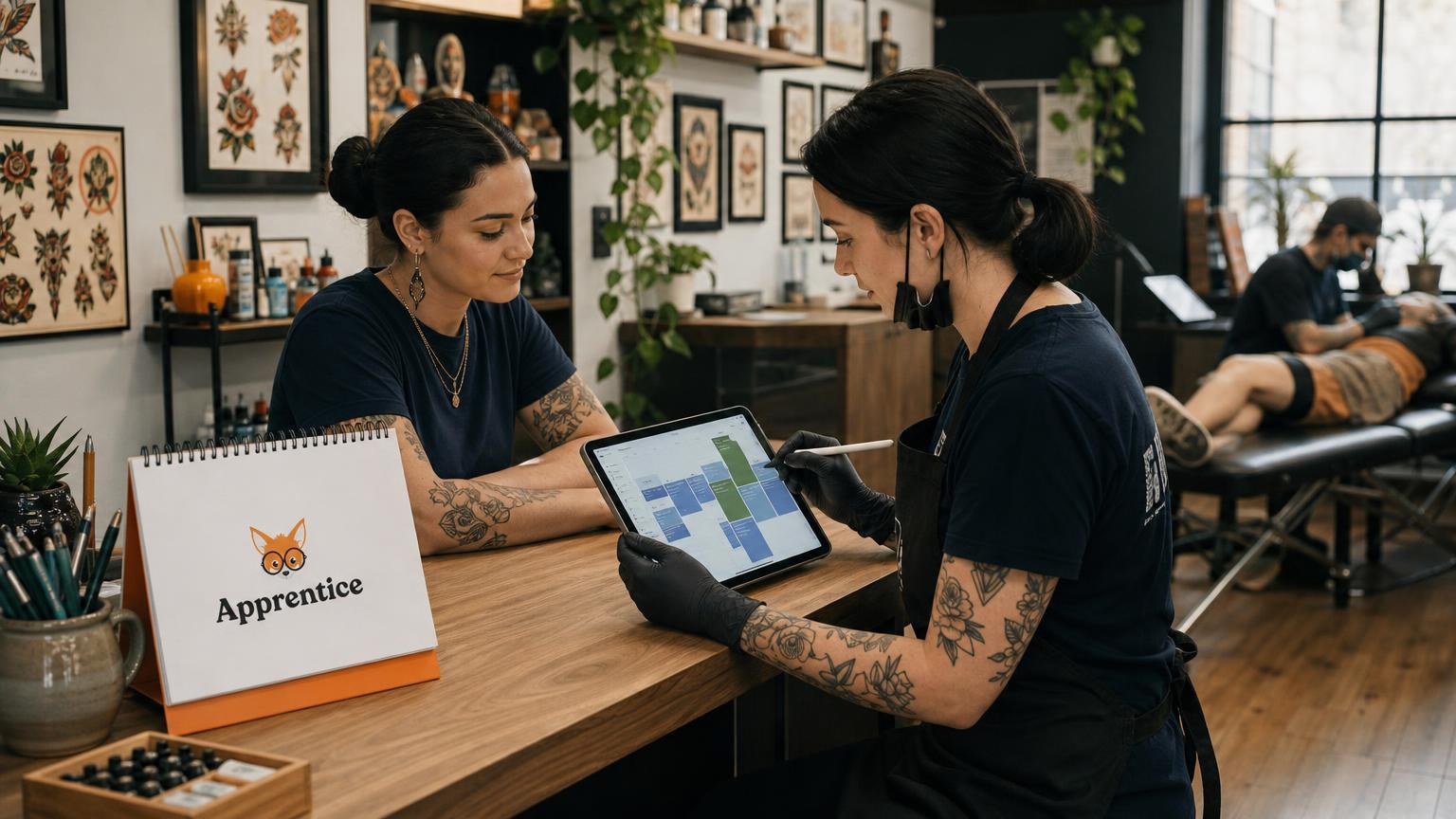
A tool like Apprentice can help here. It stores client profiles, consent forms, and appointment histories in one place. No paper stacks, no lost files. Everything’s tied to the client and the project.
Disclosure Requirements
Where a local permit is required, studios must post it in a visible location. You’re also required to display information about aftercare procedures and potential risks of tattooing. This isn’t optional decoration. Inspectors check for it.
Penalties
Where a local permit is required, operating without one can bring fines and, for repeat violations or serious sanitation failures, closure orders — the specific penalties are set by your municipality or county. Criminal charges apply under state law if you tattoo a minor without proper consent. Understanding the lawsuits a noncompliant shop can face makes clear why fines are just the floor — civil liability can hit far harder. Local health departments don’t play around with enforcement.
Tattoo Studio Fees and Costs in Pennsylvania
Money matters. Here’s what you’ll actually spend to get legal and stay legal.
| Fee Type | Estimated Cost | Frequency |
|---|---|---|
| Establishment Permit Application (local) | $100 - $300 | Annual |
| Practitioner Permit (per artist, where required) | $50 - $100 | Annual |
| Bloodborne Pathogen Training | $25 - $75 per person | Every 1-2 years |
| Autoclave Spore Testing | $15 - $40 per test | Monthly |
| General Liability Insurance | $500 - $2,000/year | Annual |
| Business License (municipal) | $50 - $200 | Varies |
| Zoning Permit (if required) | $100 - $500 | One-time |
| Inspection Re-check Fee | $50 - $150 | As needed |
Insurance Costs
General liability insurance isn’t technically mandated by state law for all studios. But here’s the reality: most landlords require it. Many municipalities require it. And operating without it is reckless. A single claim from a client alleging an infection or allergic reaction can bankrupt a small shop. Before you shop for a policy, review the insurance coverage your Pennsylvania studio actually needs — what you think covers you often has gaps. Expect to pay $500 to $2,000 annually depending on your coverage limits, number of artists, and claims history.
Hidden Costs
Don’t forget the buildout. Your studio needs proper ventilation, non-porous flooring, handwashing stations in every work area, and separate sterilization space. These aren’t optional design choices. They’re code requirements. Buildout costs vary wildly, but budget at least $5,000 to $15,000 for a compliant space if you’re starting from scratch.
How to Get Licensed for Tattoo Studio in Pennsylvania
Here’s the step-by-step process. Follow it in order.
-
Choose your location. Before you apply for anything, confirm that your space is zoned for a body art establishment. Contact your local zoning office. Some municipalities restrict tattoo studios to certain commercial zones. Getting this wrong wastes months.
-
Register your business. File with the PA Department of State. Choose your business structure: sole proprietorship, LLC, or corporation. Get your EIN from the IRS. Open a business bank account.
-
Build out your space. Your studio must meet health code requirements before inspection. That means non-porous surfaces, proper lighting, handwashing stations, a separate sterilization area, and an autoclave. Don’t cut corners here. Failed inspections cost time and money.
-
Complete bloodborne pathogen training. Every artist in your shop needs current certification. Use an OSHA-accepted training provider. Keep copies of all certificates on file.
-
Apply for your local establishment permit. Submit your application to your municipal or county health department, if it requires one. Include your floor plan, equipment list, sanitation procedures, and proof of training for all practitioners.
-
Apply for practitioner permits. Where your locality licenses artists, each one files their own application. They’ll need to submit proof of bloodborne pathogen training and identification.
-
Schedule and pass your inspection. A health inspector will visit your studio. They’ll check your sterilization equipment, sanitation procedures, record-keeping systems, and physical space. Read about what to expect during a health inspection so you’re not caught off guard. Fix any issues immediately if you receive a conditional pass.
-
Obtain municipal permits. Depending on your city or township, you may need a local business license, occupancy permit, or signage permit. Check with your municipal clerk’s office.
-
Get insurance. Secure general liability coverage before your first client. Shop around. Get quotes from at least three providers who cover body art businesses.
-
Open your doors. Once any required local permits are approved and posted, you’re legal. Set up your booking system, start taking clients, and keep your records clean from day one.
The whole process takes 6 to 12 weeks if you’re organized. Delays usually come from zoning issues or failed inspections. Get ahead of those early.
And speaking of booking systems: Apprentice lets you set up secure booking links, collect deposits automatically, and send appointment reminders without lifting a finger. That means fewer no-shows and less time chasing clients on your first week open.
Pennsylvania Tattoo Studio Resources and Contacts
You’ll need these. Bookmark them.
- Your local health department: The actual regulator for body art in Pennsylvania. Programs like the Philadelphia, Allegheny County, and Erie County health departments set and enforce permit, inspection, and fee rules. Check your municipality or county for contact info.
- Pennsylvania Department of Health: Provides statewide public health guidance, though it does not license body art studios. Website: health.pa.gov. Phone: (877) 724-3258.
- PA Department of State (Business Registration): File your business entity here. Website: dos.pa.gov.
- OSHA Bloodborne Pathogen Training: Find accredited providers at osha.gov. Search for body art or tattoo-specific courses.
- Local Health Departments: Many counties have their own health departments that handle inspections and licensing. Check your county’s website for contact info.
- Alliance of Professional Tattooists (APT): A nonprofit focused on safety standards and education for tattoo professionals. Website: safe-tattoos.com.
- Small Business Development Centers (SBDC): Free business consulting for PA entrepreneurs. Find your local center at pasbdc.org.
Keep a folder with all your license numbers, inspection reports, and insurance documents. Digital or physical, it doesn’t matter. Just make sure you can access everything fast when an inspector shows up unannounced. Because they will.
County and City Tattoo Requirements in Pennsylvania
How to read this local research: County and city body-art rules are not consistently published in one place. We checked official state and local sources and publish only the findings those sources support. A “Confirm with…” line means the public record was missing, outdated, inaccessible, or contradictory. It is not a fee estimate and it is not proof that no requirement exists.
Philadelphia (city)
Research status: 1 of 7 core fields has publishable findings · High confidence · Verify final fees and filing steps with the agency before applying.
- Governing agency: Philadelphia Department of Public Health — Environmental Health Services (Environmental Engineering Office) — official phila.gov source
- Studio permit: Confirm with Philadelphia Department of Public Health — Environmental Health Services (Environmental Engineering Office) before relying on this — official phila.gov source
- Per-artist requirements: Confirm with Philadelphia Department of Public Health — Environmental Health Services (Environmental Engineering Office) before relying on this — official phila.gov source
- Startup cost: Confirm with Philadelphia Department of Public Health — Environmental Health Services (Environmental Engineering Office) before relying on this — official phila.gov source
- Time to open: Confirm with Philadelphia Department of Public Health — Environmental Health Services (Environmental Engineering Office) before relying on this — official phila.gov source
- Minimum client age: Confirm with Philadelphia Department of Public Health — Environmental Health Services (Environmental Engineering Office) before relying on this — official phila.gov source
- Renewals: Confirm with Philadelphia Department of Public Health — Environmental Health Services (Environmental Engineering Office) before relying on this — official phila.gov source
Last verified: 2026-08-16 · Research confidence: high
Allegheny County (county)
Public information is limited — low confidence. 1 of 7 core fields has publishable findings. Key local permit, fee, or timing details were unavailable, outdated, or contradictory in accessible official sources. Treat this section as a research lead and confirm the requirements directly with the agency before acting.
- Governing agency: Allegheny County Health Department — official alleghenycounty.us source
- Studio permit: Confirm with Allegheny County Health Department before relying on this — official alleghenycounty.us source
- Per-artist requirements: Confirm with Allegheny County Health Department before relying on this — official alleghenycounty.us source
- Startup cost: Confirm with Allegheny County Health Department before relying on this — official alleghenycounty.us source
- Time to open: Confirm with Allegheny County Health Department before relying on this — official alleghenycounty.us source
- Minimum client age: Confirm with Allegheny County Health Department before relying on this — official alleghenycounty.us source
- Renewals: Confirm with Allegheny County Health Department before relying on this — official alleghenycounty.us source
Last verified: 2026-08-16 · Research confidence: low
Montgomery County (county)
Research status: 7 of 7 core fields have publishable findings · High confidence · Verify final fees and filing steps with the agency before applying.
- Governing agency: Montgomery County Office of Public Health (Department of Health and Human Services) — official montgomerycountypa.gov source
- Studio permit: No tattoo/body-art establishment permit exists. The Office of Public Health's full 'Available Permits and Licenses' list — Camps and Campgrounds, Certified Food Safety Manager, Eating and Drinking Establishment, Farmer's Market Vendor, Individual Water Supply Well Permitting, Liquid Waste Management, Mobile Home Parks, On-Lot Sewage Permitting, Public Bathing Places, Temporary Food Service — does not include tattoo, body art, or body piercing.
- Per-artist requirements: None — no county-level body-art artist certification found.
- Startup cost: $0 in county-specific body-art fees — no local permit exists to open a tattoo/body-art studio here beyond ordinary, non-body-art-specific county requirements.
- Time to open: Not applicable — no county body-art plan-review or inspection process exists.
- Minimum client age: Not addressed by Montgomery County; defer entirely to the Pennsylvania state guide.
- Renewals: Not applicable — there is no county permit to renew.
Ordinance: official montgomerycountypa.gov source
Last verified: 2026-08-16 · Research confidence: high
Erie County (county)
Public information is limited — medium confidence. 2 of 7 core fields have publishable findings. Erie County does not publish every current permit, fee, or timing detail in an accessible official source. Use the supported findings below as a starting point and confirm every marked gap directly with the agency.
- Governing agency: Erie County Department of Health — official eriecountypa.gov source
- Studio permit: Confirm with Erie County Department of Health before relying on this — official eriecountypa.gov source
- Per-artist requirements: Confirm with Erie County Department of Health before relying on this — official eriecountypa.gov source
- Startup cost: Confirm with Erie County Department of Health before relying on this — official eriecountypa.gov source
- Time to open: Confirm with Erie County Department of Health before relying on this — official eriecountypa.gov source
- Minimum client age: Not addressed by Erie County; defer entirely to the Pennsylvania state guide.
- Renewals: Confirm with Erie County Department of Health before relying on this — official eriecountypa.gov source
Last verified: 2026-08-16 · Research confidence: medium
Sources & Official References
Pennsylvania has no statewide body art license, so the primary sources are the one statewide statute on minors plus your local health department’s program. Confirm requirements with the department that covers your location.
- 18 Pa.C.S. § 6311 (tattooing/body-piercing of minors)
- Pennsylvania Department of Health
- Erie County Department of Health — tattoos and body piercing program (a local-option example; search the Erie County Health Department site for current permit and fee details)
Pennsylvania Tattoo Studio FAQ
Do I need a license to tattoo in Pennsylvania? It depends on where you are. Pennsylvania has no statewide tattoo license. Many municipalities and counties require a local establishment permit for the studio and a practitioner permit for each artist, while others have lighter rules. Check with your local health department to confirm what applies to you.
Can I tattoo from home in Pennsylvania? Technically, the regulations apply to any location where tattooing occurs. But most municipalities zone tattoo studios as commercial businesses. Running a home studio without proper zoning approval and licensing is illegal and puts your clients at risk.
Does Pennsylvania accept tattoo licenses from other states? There’s no statewide PA license to transfer into. Because permitting is local, you’ll register with the health department where you set up shop and meet its requirements. Your bloodborne pathogen training generally carries over if it’s from an accredited provider and still current.
How often do I need to renew my permit? Renewal cadence is set locally, but most municipalities that require permits renew establishment and practitioner permits annually. Don’t wait until the last minute. Start your renewal paperwork at least 30 days before expiration.
What happens if I operate without the required permits? Where a local permit is required, operating without one can bring fines and, for repeated violations, forced closure — local penalties vary. Separately, tattooing a minor without proper consent carries criminal penalties under state law.
Do I need an autoclave? If you use any reusable equipment, yes. And you need to run spore tests monthly to verify it’s working correctly. Results must be documented and kept on file.
What insurance do I need? General liability insurance is strongly recommended. It covers claims related to bodily injury, property damage, and professional errors. Some policies also cover product liability for ink reactions.
Can an apprentice tattoo clients in Pennsylvania? An apprentice can work under the supervision of an experienced practitioner. Where your local health department permits artists individually, the apprentice still needs their own permit and current bloodborne pathogen certification. Supervision doesn’t waive a local permit requirement.
The Bottom Line
Running a tattoo studio in Pennsylvania means respecting the craft and the rules that protect it. The licensing process isn’t complicated, but it demands attention. Every form, every inspection, every renewal matters. Skip a step and you risk your livelihood. Handle it right and you build a shop that lasts.
The best studios treat compliance as a foundation, not a burden. It’s permanent. It’s personal. People want it to be perfect. That applies to the art and the business behind it.
If you’re ready to stop wrestling with admin work and focus on what you actually love, Apprentice can help you manage bookings, deposits, and client prep from day one. Get started free for 14 days and see how much time you get back.

Jason Howie
Founder & CEO
Jason Howie is the founder of Apprentice, passionate about empowering tattoo artists and shops with better tools to manage their business and serve their clients.