Someone in your city is typing “fine line tattoo near me” into their phone right now. They’ve already decided they want it. The only question is whose name shows up first. That’s the whole game. Tattoo SEO doesn’t mean gaming Google. It means being the obvious answer when a ready-to-book client goes looking.
The audience is huge and getting bigger. About 32% of American adults have at least one tattoo, and the numbers run higher among Millennials and Gen Z. The U.S. tattoo and removal market is a roughly $4.5 billion industry. Globally the tattoo market is projected to hit around $4.10 billion by 2031. More clients means more shops fighting for the same screen. Showing up isn’t a bonus anymore. It’s how you keep the chair full.
Rank for the style, not just “tattoo shop”
Here’s where most shops waste their effort. They try to rank for “tattoo shop” and get buried under a hundred competitors and a few national chains. Skip it.
People search the way they think. They type “custom sleeve tattoo,” “fine line script,” “blackwork artist,” “cover-up specialist.” Those searches are gold, because the person already knows what they want and is close to booking. Build a page for each style your shop actually does well. Name the style in the heading. Name it in the page URL. Show the work that proves you can do it.
Don’t fake styles you don’t do. If nobody in your shop does realism, don’t build a realism page. You’ll pull in consultations you have to turn away, and a wasted booking slot is worse than no booking at all.
Local is the whole ballgame
A tattoo is an in-person job. Nobody’s flying across the country for a forearm piece. That means your real competition is the shops within driving distance, and local search is where you win or lose.
Start with your Google Business Profile. Claim it, fill in every field, pin the correct address, list your real hours, and add fresh photos of recent work. This single listing decides whether you show up in the map results, and the map results sit above everything else on the page.
Then say where you are on your own site. Put your neighborhood and city in your page titles and your copy. Mention the landmarks people actually use to describe your area. If you’ve got more than one location, give each its own page. For the deeper playbook, here’s how local SEO gets your shop found nearby.
Reviews do the convincing you can’t
Getting a tattoo means trusting a stranger with a needle and your permanent skin. People are nervous, and they read reviews before they ever message you. Reviews also feed straight into your local ranking, so they pull double duty.
Ask for them. The best moment is right after a session, when the client is still buzzing about a piece they love. A quick “if you’re happy, a Google review really helps the shop” works better than any automated email.
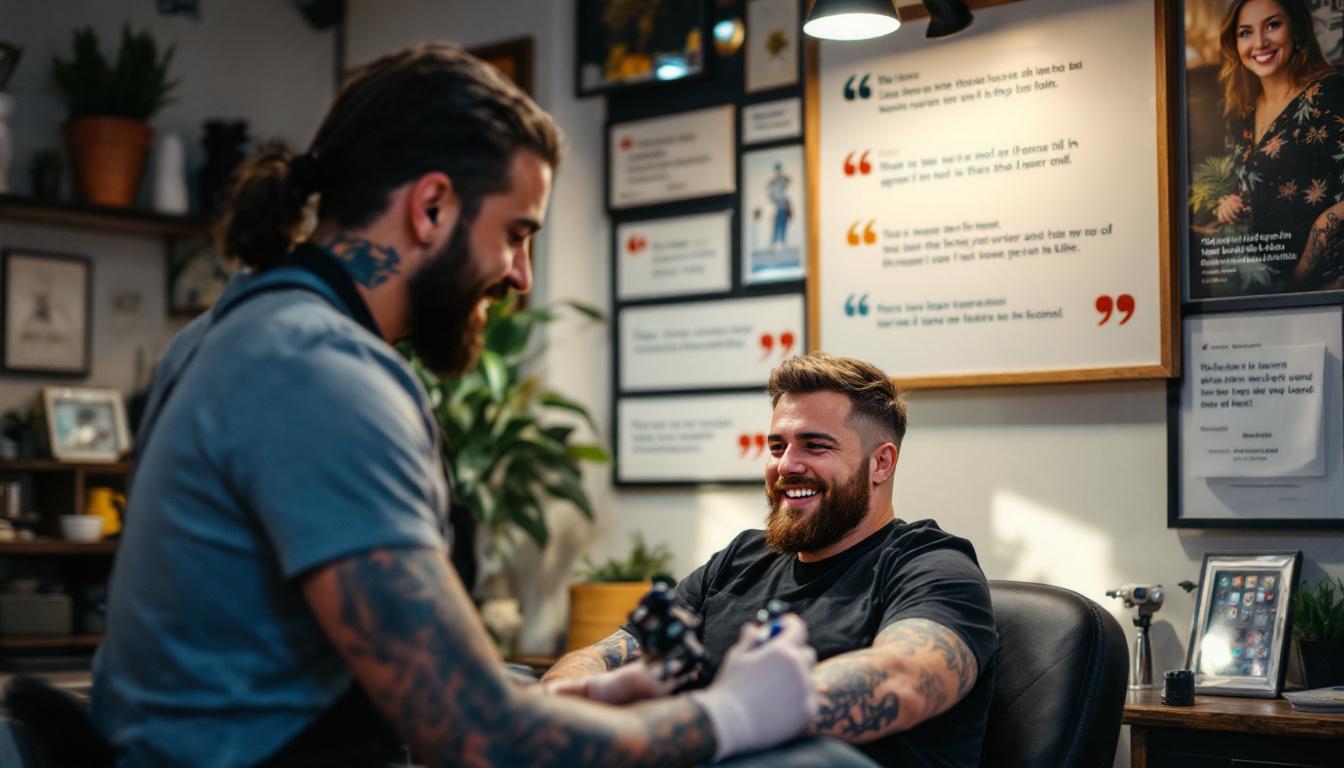
Reply to the reviews you get, the good and the rough ones. A calm, professional answer to a complaint tells the next reader you’re a real shop that stands behind its work. It tells Google you’re active too. Pull a few of your best testimonials onto your site so visitors see them without leaving your page.
If your site is slow on a phone, you’ve already lost
Almost everyone finds you on a phone, usually standing in line or lying on the couch. If your site takes five seconds to load, they’re gone before your portfolio even appears. Google watches that bounce and quietly drops you down the page.
Compress your images. A portfolio is mostly heavy photos, and uncompressed shots are the number one reason tattoo sites crawl. Test your own site on your phone over cell data, not the shop’s wifi. Make sure the booking button is big enough to tap with a thumb and easy to find without scrolling.
Speed is a trust signal. A fast, clean site says you run a tight shop. A slow, broken one makes people wonder how careful you are with a tattoo machine.
Tell the story behind the piece
A portfolio image with no words is a dead end for search. A short story around it is content Google can read and people want to share.
Write a few sentences about the work. What the client wanted, the problem you solved, the choice that made the piece land. Cover-ups are perfect for this, because the before-and-after is dramatic and the search demand is real. Aftercare guides pull steady traffic too, since every fresh client is going to search “tattoo aftercare” within a day of leaving your chair.
You don’t need to write like a marketer. Write like you talk to a client in the consult. Plain, honest, specific. That’s the voice people trust, and it’s the voice search engines have learned to reward.

Social and video feed the same machine
Instagram and TikTok are where tattoo work spreads. A timelapse of a sleeve coming together, a clean reveal shot, a quick walkthrough of your aftercare routine. That content builds the following that eventually lands on your site.
Link back every time. Put your booking page in your bio and point people there in your captions. Likes for their own sake don’t pay rent. What you want is to turn a scroll into a click onto your site, and a click into a booked consult. A short shop tour or an aftercare clip embedded on your site keeps visitors there longer, which is its own quiet ranking signal.
The tech is changing, and that’s fine
AI has reached the needle itself. In 2025, Austin startup Blackdot launched A.E.R.O., billed as the first AI-powered tattoo device, now in use at Bang Bang Tattoo in New York. It pairs lasers, computer vision, and micro-needles for fine-line work.
Whether or not a robot ever touches your station, the lesson holds. Tools change, and the shops that pay a little attention stay ahead. On the SEO side that just means writing clear answers to the questions clients actually ask, so an AI search result or a Google snippet can pull from your page instead of someone else’s.
Where it all leads
SEO for a tattoo shop comes down to a handful of honest moves. Rank for the styles you really do. Win your local map listing. Earn real reviews and answer them. Keep your site fast on a phone. Tell the story behind the work. Do those well and the right clients find you, the ones who already know what they want and are ready to book.
Once they book, the back-end matters as much as the search. Apprentice handles the scheduling, deposits, design sharing, and client messaging so a full calendar doesn’t turn into a full inbox. If your SEO is working, you’ll want the booking side to keep up. Start a free trial and see how it runs in your shop.

Jason Howie
Founder & CEO
Jason Howie is the founder of Apprentice, passionate about empowering tattoo artists and shops with better tools to manage their business and serve their clients.