
Your portfolio is the first thing a client sees and the last thing they think about before they message you. Everything else, your prices, your shop, your chair-side manner, comes after. The work decides whether they ever walk in.
So most of running a studio is downstream of one question: does the work in front of people make them want to book? Scheduling, payments, marketing, all of it matters. But none of it saves a thin or out-of-date portfolio.

Clients today do their homework. They know the difference between fine-line and bold traditional, and they show up looking for the artist who does the exact thing they want. Your portfolio is how they find out if that’s you. Treat it like the marketing tool it is, not a scrapbook.
Show your best work, not all of it
Bold will hold, and so will this rule: quality beats quantity every time. Twelve great pieces sell better than forty average ones. A client scrolling your work isn’t counting. They’re forming an impression, and one weak photo drags the whole set down.
Pick pieces that show your skill, your line quality, and the style you actually want to do more of. If you want more black-and-grey realism, lead with black-and-grey realism. People book what they see. Fill your portfolio with flash you’re sick of and that’s the work that walks through your door.
Range helps too, within reason. A few different styles tell clients you’re versatile. But don’t confuse range with sprawl. If every photo looks like a different artist made it, nobody knows what they’re getting.
Keep it fresh
A portfolio is never finished. The work you were proud of two years ago probably isn’t your best anymore, and leaving it up tells clients you peaked a while back.
Add new pieces as you make them. Pull old ones that no longer match where your skill is now. An active, current portfolio signals that you’re working and improving. A stale one signals the opposite, even if you’re busier than ever.
If a style is having a moment and you do it well, get examples up while people are searching for it. Timing matters. The client who wants that thing right now is going to book the artist who’s clearly doing it right now.
Make the photos worth looking at
The work can be great and still photograph badly. Bad lighting, a busy background, a blurry shot, any of these can sink a piece that looked incredible in person.

Shoot in soft, even light. Keep the background plain. Get the whole piece in frame and in focus. If you’re posting online, compress the images so pages load fast, because a slow gallery loses people before they ever see the work. None of this is expensive. It’s just attention.
Let the software handle the rest
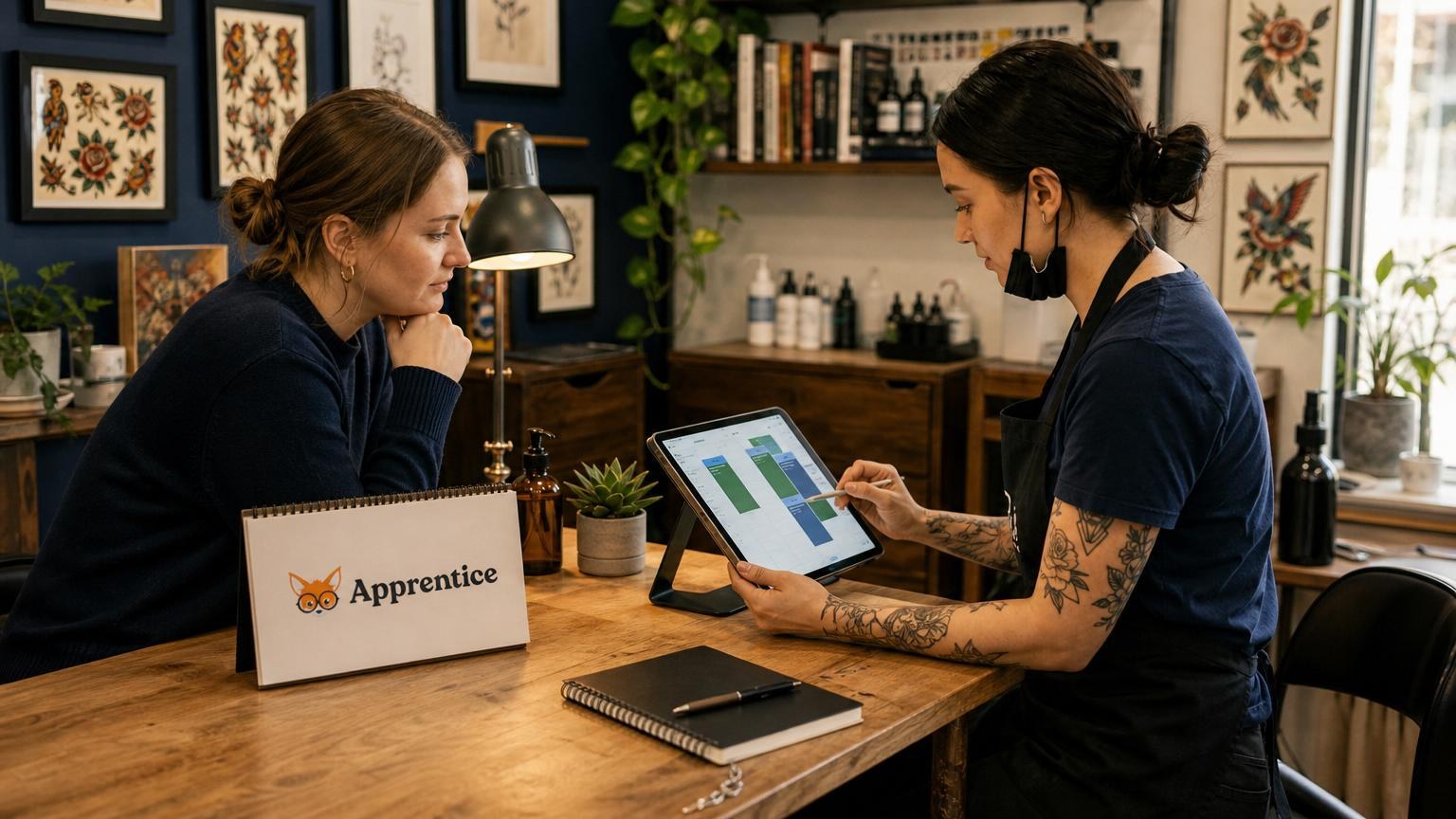
Once the work is doing its job, the booking that follows shouldn’t eat your day. That’s where a little tooling earns its keep. Online booking lets clients grab a slot without the back-and-forth, which cuts down on the messages you answer at midnight. Apprentice keeps your schedule, your clients, and your numbers in one place, so you can see your booking patterns and plan around them instead of guessing.
There are AI design tools now that speed up concept work and stencil prep, too. None of this replaces the art. It just clears the admin out of the way so you spend more time tattooing and less time managing a calendar.
Where this is going
Custom work keeps growing. Clients want a tattoo that’s theirs, tied to their own story, not a design a hundred other people already have. The artists who can draw a real custom piece, and prove it in their portfolio, have the edge.
The tech is moving too. Bang Bang’s A.E.R.O. robotic tattoo system is one early example of where automation might go. Whether or not that ever reaches your shop, the point holds: the artists who keep their work sharp and their portfolio current are the ones who stay booked.
Tattoos aren’t a niche anymore. 32% of Americans have one, per Pew’s 2023 survey, and 22% have more than one. The clients are out there. Your portfolio is how they decide it’s you.
Want the calendar, clients, and design tools in one spot so you can spend less time on admin and more on the work? Try Apprentice free and see if it fits how you run your shop.

Jason Howie
Founder & CEO
Jason Howie is the founder of Apprentice, passionate about empowering tattoo artists and shops with better tools to manage their business and serve their clients.