Quick answer
What do you need to open a tattoo studio in Nevada?
To open a tattoo studio in Nevada, you need a Body Art Establishment Permit from your local health district and a Body Art Practitioner Permit for each artist, current OSHA bloodborne pathogen training, CPR/First Aid certification, a spore-tested autoclave, and a business license. Expect $300–$1,200 in startup licensing and a 4–8 week timeline.
- Regulated by: Local health districts (Southern Nevada Health District, Washoe County Health District) under NAC Chapter 444; Nevada has no state-level tattoo license
- Studio permit: Body Art Establishment Permit ($350–$600 initial, annual)
- Per artist: Body Art Practitioner Permit + bloodborne pathogen training and CPR/First Aid certification
- Startup permit cost: $300–$1,200 depending on county
- Time to open: 4–8 weeks from application (longer if you fail inspection)
- Minimum client age: 18, or under 18 with written parental/guardian consent + parent present (under-14 prohibited)
- Renewals: Annual for both establishment and practitioner permits
- Official source: Southern Nevada Health District
Opening a tattoo studio in Nevada isn’t just about talent. It’s about paperwork, health codes, and knowing the rules before you sign a lease. The state treats body art establishments like the health-risk businesses they are. That means inspections, permits, and a licensing process that can trip you up if you’re not prepared. Whether you’re setting up shop in Las Vegas, Reno, or a smaller market like Henderson, the regulatory framework is the same. And it has teeth.
Nevada updated several health district guidelines heading into 2026. Some fees changed. Some documentation requirements got tighter. If you’re planning to open a studio or bring your existing shop into full compliance, you need the current playbook. This guide to Nevada tattoo studio requirements for 2026 covers everything: licensing, regulations, costs, step-by-step instructions, and the official contacts you’ll need along the way.
The unsexy stuff matters. Getting your autoclave logs right, your consent forms dialed in, and your bloodborne pathogen training current: that’s what separates a legit operation from a shop waiting to get shut down. Let’s get into it.
Nevada Tattoo Studio Requirements at a Glance
Here’s the quick version for those who need answers fast.
- License type: Body Art Establishment Permit (issued by your local health district)
- Individual license: Body Art Practitioner Permit (required for every artist)
- Bloodborne pathogen training: Required before you apply. Must be current.
- CPR/First Aid certification: Required in most jurisdictions
- Facility inspection: Mandatory before opening. Must pass health and safety standards.
- Estimated startup licensing costs: $300 to $1,200 depending on your county
- Renewal period: Annual for both establishment and practitioner permits
- Timeline from application to approval: 4 to 8 weeks (longer if you fail inspection)
- Insurance: General liability required. Some landlords also require property coverage.
- Autoclave testing: Spore testing required monthly, with logs available for inspection
If you’re a solo artist working out of a private studio, you still need both permits. Nevada doesn’t give exemptions for small operations. The rules apply whether you’re running a 10-chair shop on the Strip or a one-room studio in Sparks.
Keep this list handy. We’ll break each item down in the sections below.
Nevada Tattoo Studio Licensing Requirements
Nevada doesn’t issue tattoo licenses at the state level. Instead, your local health district handles everything. The two biggest are the Southern Nevada Health District (SNHD) covering Clark County and the Washoe County Health District covering Reno and surrounding areas. Smaller counties defer to similar local health authorities.
Establishment Permit
You need a Body Art Establishment Permit before you open your doors. This permit confirms your physical space meets health and safety standards. The health district will inspect your studio for proper ventilation, handwashing stations, sterilization equipment, and waste disposal systems. Your autoclave must be functioning and spore-tested. You’ll also need a designated clean area separated from your work stations.
The application requires your business license, a floor plan of your studio, and proof of a current waste disposal contract with a licensed medical waste hauler. Don’t skip the floor plan. Inspectors use it to verify your layout matches what you submitted.
Practitioner Permit
Every artist in your shop needs their own Body Art Practitioner Permit. This is non-transferable and tied to the individual. To qualify, you must complete a bloodborne pathogen training course that meets OSHA standards. Most health districts also require CPR and First Aid certification from an accredited provider like the American Red Cross or American Heart Association.
You’ll submit proof of training, a completed application, government-issued ID, and your fees. Some districts also require a brief interview or orientation session before issuing the permit.
Continuing Education
Nevada doesn’t have a formal continuing education mandate at the state level. But bloodborne pathogen training must stay current, which typically means renewing it annually. CPR/First Aid certifications usually expire every two years. If either lapses, your practitioner permit can be suspended until you’re back in compliance.
And here’s the reality check: inspectors do ask for documentation during surprise visits. If you can’t produce current training records on the spot, that’s a violation. Keep digital and physical copies at your workstation.
Nevada-Specific Regulations and Laws
Nevada regulates tattoo studios primarily through Nevada Administrative Code (NAC) Chapter 444, which covers public health and sanitation. Local health districts then add their own layers of enforcement. You’re accountable to both.
Age and Consent Laws
Nevada has no statewide ban on tattooing minors. Instead, your local health district sets the rules, and the major districts (Southern Nevada Health District, Washoe County) allow tattooing someone under 18 with written parental or guardian consent, valid ID, and the parent present during the procedure. Children under 14 may not be tattooed at all — see Nevada’s rules on tattooing minors for the full legal picture. If you tattoo a minor without proper consent, you’re looking at a possible misdemeanor charge and likely losing your permits. Check IDs every time, confirm the parent is present, and keep the signed consent on file. No exceptions.
For clients aged 18 and over, you must collect a signed consent form before every procedure. That form needs to include the client’s name, date of birth, a description of the procedure, and acknowledgment of risks including infection and allergic reaction — review what a tattoo consent form must include to make sure yours covers every required element. Store these records for at least three years.
Sanitation and Sterilization
Your studio must follow strict sanitation protocols. Single-use needles and tubes are mandatory. Reusable equipment must be sterilized in an autoclave, and you need to run biological indicator (spore) tests at least monthly. Keep a log of every test with dates and results. Inspectors will review it.
Workstations must be cleaned and disinfected between every client. You need hospital-grade disinfectant, disposable barriers on all surfaces that could contact blood or bodily fluids, and proper sharps disposal containers. Cross-contamination is the fastest way to get shut down.
Disclosure Requirements
You’re required to post your establishment permit in a visible location. Clients must be able to see it without asking. Your artists’ individual permits should also be accessible. Some districts require you to display your most recent inspection score as well.
Penalties for Non-Compliance
Violations can result in fines ranging from $100 to $1,000 per incident. Repeat violations or serious health hazards can lead to permit revocation and forced closure. Operating without a permit is a misdemeanor under Nevada law. The health district can also issue a cease-and-desist order with immediate effect if they find imminent health risks during an inspection. Understand the lawsuits a noncompliant shop can face before you find out the hard way.
Tattoo Studio Fees and Costs in Nevada
Money talk. Here’s what you’ll actually pay to get legal and stay legal.
Fee Breakdown Table
| Fee Type | Clark County (SNHD) | Washoe County |
|---|---|---|
| Establishment Permit (initial) | $400 - $600 | $350 - $500 |
| Establishment Permit (renewal) | $300 - $500 | $250 - $400 |
| Practitioner Permit (initial) | $100 - $200 | $75 - $150 |
| Practitioner Permit (renewal) | $75 - $150 | $50 - $100 |
| Re-inspection fee | $100 - $200 | $100 - $150 |
| Bloodborne pathogen course | $25 - $75 | $25 - $75 |
| CPR/First Aid certification | $50 - $100 | $50 - $100 |
| Business license | $200 - $500 | $150 - $400 |
Fees vary by district and can change annually. Always confirm current amounts directly with your health district before submitting payment.
Insurance Costs
General liability insurance for a tattoo studio typically runs $500 to $2,000 per year depending on your coverage limits, location, and number of artists. Some carriers offer policies specifically designed for body art businesses. You want at least $1 million per occurrence and $2 million aggregate. Your landlord will almost certainly require proof of coverage before you sign a lease. See the insurance coverage your Nevada studio actually needs for a full breakdown of what to buy and what most shops overlook.
Hidden Costs
Don’t forget the stuff that doesn’t show up on the fee schedule. Medical waste disposal contracts run $50 to $150 per month. Autoclave spore testing kits cost around $30 to $60 per month if you’re testing weekly (which is smart even though monthly is the minimum). And if you fail your initial inspection, that re-inspection fee adds up fast. Budget for it.
How to Get Licensed for Tattoo Studio in Nevada
Here’s the step-by-step process. Follow it in order and you’ll save yourself weeks of back-and-forth.
-
Register your business entity. File with the Nevada Secretary of State. Choose your structure: LLC, sole proprietorship, or corporation. Get your EIN from the IRS.
-
Obtain a local business license. Apply through your city or county clerk’s office. You can’t apply for health permits without this.
-
Complete bloodborne pathogen training. Take an OSHA-compliant course. Keep your certificate. You’ll need it for the practitioner permit application.
-
Get CPR and First Aid certified. Use an accredited provider. Make sure the certification won’t expire before your permit is issued.
-
Secure your studio location. Sign your lease. Make sure the space meets zoning requirements for a body art establishment. Check with your city’s planning department before committing.
-
Build out your studio to code. Install handwashing stations, proper ventilation, designated clean and dirty areas, and an autoclave station. Refer to NAC 444 for specific requirements.
-
Set up a medical waste disposal contract. Partner with a licensed hauler. You’ll need proof of this contract for your application.
-
Submit your Body Art Establishment Permit application. Include your floor plan, business license, waste disposal contract, and fees. Submit to your local health district.
-
Pass your facility inspection. The health district will schedule an on-site inspection. Everything must be set up and operational. Have your autoclave, sterilization logs, and supplies ready. Read up on what to expect during a health inspection so nothing catches you off guard.
-
Submit individual Practitioner Permit applications. Each artist files separately with their training certificates, ID, and fees.
-
Receive your permits and open. Once both establishment and practitioner permits are approved, you’re legal. Post them visibly.
Expect the entire process to take 4 to 8 weeks from your first application submission. If you fail inspection, add another 2 to 3 weeks for re-inspection scheduling.
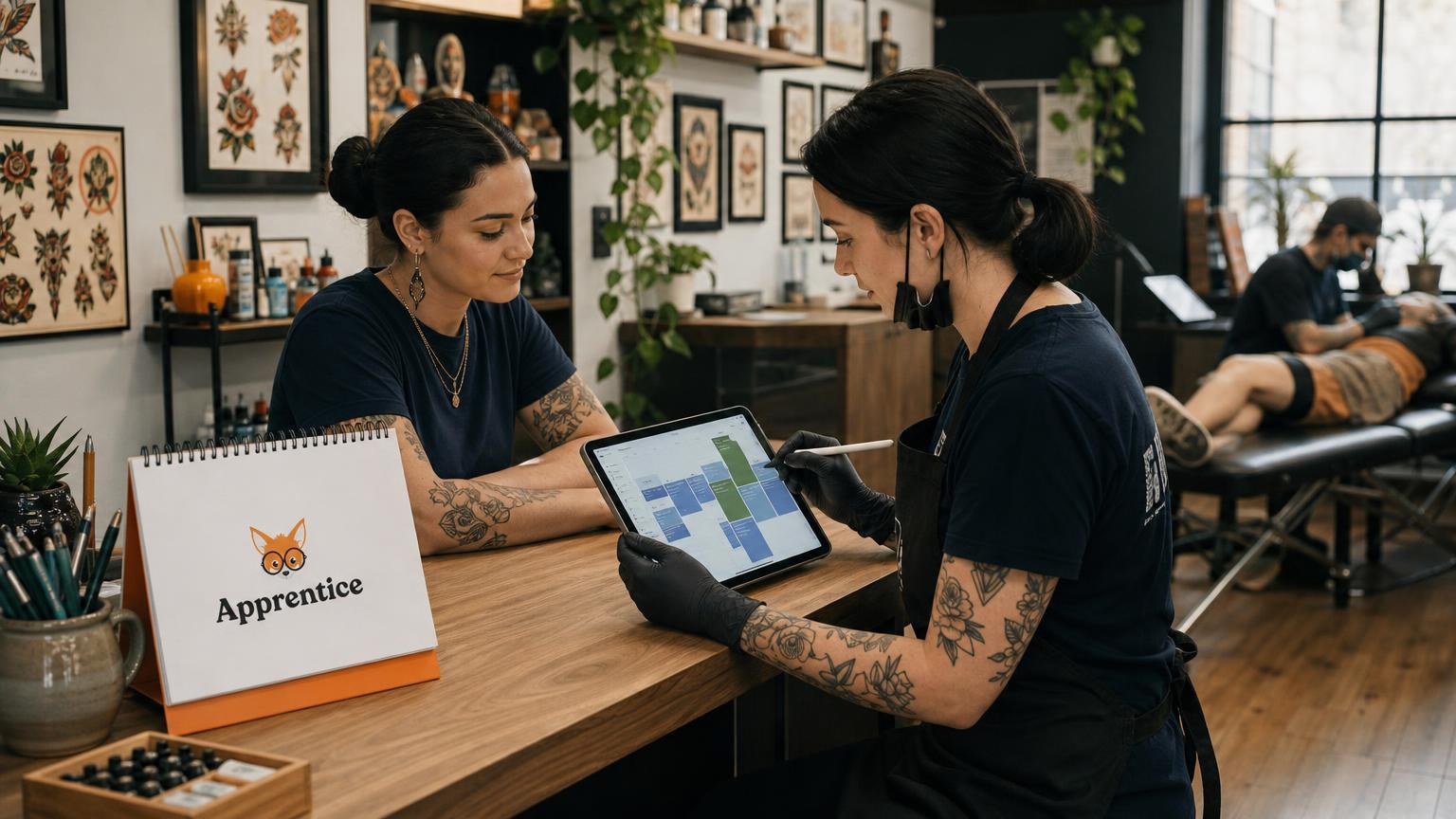
One thing that helps enormously during this phase: getting your booking and client management system set up before you open. Tools like Apprentice let you start collecting deposits, managing appointments, and sending automated consent forms from day one. That means when you get your permits, you’re not scrambling to figure out admin. You’re ready to tattoo.
Nevada Tattoo Studio Resources and Contacts
Bookmark these. You’ll reference them more than once.
Southern Nevada Health District (Clark County)
- Phone: (702) 759-1258
- Website: Southern Nevada Health District
- Body Art Program page: Search “body art” on their site for current applications and fee schedules
- Address: 280 S. Decatur Blvd., Las Vegas, NV 89107
Washoe County Health District
- Phone: (775) 328-2434
- Website: Washoe County Health District
- Address: 1001 E. Ninth St., Building B, Reno, NV 89512
Nevada Secretary of State (Business Registration)
- Phone: (775) 684-5708
- Website: Nevada Secretary of State
- Online filing portal: SilverFlume
Other Helpful Contacts
- Nevada State Board of Health: For questions about NAC 444 and statewide health regulations
- OSHA Training Institute: For bloodborne pathogen course providers
- Alliance of Professional Tattooists (APT): Industry resources and best practice guidelines at safe-tattoos.com
If you’re in a smaller county like Carson City, Elko, or Nye, contact your county health department directly. Their requirements mirror the larger districts but may have slightly different fee structures.
County and City Tattoo Requirements in Nevada
How to read this local research: County and city body-art rules are not consistently published in one place. We checked official state and local sources and publish only the findings those sources support. A “Confirm with…” line means the public record was missing, outdated, inaccessible, or contradictory. It is not a fee estimate and it is not proof that no requirement exists.
Southern Nevada Health District (Clark County / Las Vegas, Henderson, North Las Vegas, Laughlin, Mesquite) (health-district)
Research status: 4 of 7 core fields have publishable findings · High confidence · Verify final fees and filing steps with the agency before applying.
- Governing agency: Southern Nevada Health District – Environmental Health Division (Body Art Program) — official southernnevadahealthdistrict.org source
- Studio permit: Confirm with Southern Nevada Health District – Environmental Health Division (Body Art Program) before relying on this — official southernnevadahealthdistrict.org source
- Per-artist requirements: Body Art Card or Microblading Card required for every tattoo artist, permanent-makeup/microblading artist, and piercer. Mentor/apprentice system: applicant must be 18+, pass an 80%+ sanitation exam, hold current bloodborne-pathogen training, and show 6 months documented experience or complete an apprenticeship under a Mentor Body Artist. Cards renew every 2 years, separately from the facility permit's annual cycle. Fee: $175 first-time (exam $150 + card $25); renewal fees: confirm with SNHD; $25 duplicate/replacement; $150 retest
- Startup cost: Confirm with Southern Nevada Health District – Environmental Health Division (Body Art Program) before relying on this — official southernnevadahealthdistrict.org source
- Time to open: Confirm with Southern Nevada Health District – Environmental Health Division (Body Art Program) before relying on this — official southernnevadahealthdistrict.org source
- Minimum client age: Body artist/card applicant must be 18+ (verified by government ID at application). For patrons: body art on anyone under 14 is flatly prohibited; ages 14-17 require a parent/legal guardian (or emancipated-minor decree) to present ID and sign the consent form; 18+ has no restriction.
- Renewals: Facility Health Permit: annual, non-transferable (Reg. 10.7.1, 10.8). Body Art/Microblading/Mentor Cards: every 2 years; holder must retake the sanitation exam if the card lapses more than 1 year (Reg. 8.8–8.9).
Ordinance: official southernnevadahealthdistrict.org source
Last verified: 2026-08-16 · Research confidence: high
Northern Nevada Public Health (Washoe County / Reno, Sparks) (health-district)
Research status: 5 of 7 core fields have publishable findings · High confidence · Verify final fees and filing steps with the agency before applying.
- Governing agency: Northern Nevada Public Health – Environmental Health Services (Invasive Body Decoration Program) — official nnph.org source
- Studio permit: Invasive Body Decoration (IBD) Establishment Permit covers tattoo, tattoo removal, piercing, permanent makeup, microblading. Annual renewal, non-transferable. New facilities also pay a one-time Construction Plan Review fee. Fee: $445/yr Establishment Permit (effective 2026-07-01; was $431 effective 2025-07-01); $445 one-time Construction Plan Review (same schedule). Temporary event: $878 Event Coordinator permit, $430 Vendor permit (no wheels), $277 Mobile Vendor permit (wheels).
- Per-artist requirements: No separate individual operator permit, card, or NNPH-issued license exists. This is a facility-level-only permitting model. Any person performing IBD procedures must be 18+ and complete bloodborne-pathogen (BBP) training per 29 CFR 1910.1030 within 10 days of hire and annually thereafter; compliance is checked against the facility's on-site artist list/records at inspection, not billed as a per-artist fee.
- Startup cost: approximately $890 minimum in mandatory NNPH fees for a new facility: $445 one-time Construction Plan Review + $445 first-year Establishment Permit. No per-artist fee applies. Excludes local business license, building permits, and BBP training course cost.
- Time to open: Confirm with Northern Nevada Public Health – Environmental Health Services (Invasive Body Decoration Program) before relying on this — official nnph.org source
- Minimum client age: Confirm with Northern Nevada Public Health – Environmental Health Services before relying on this — official nnph.org source
- Renewals: Establishment permit: annual, non-transferable (Reg. 020.030, 020.035). Individual operators must repeat BBP training annually (Reg. 030.006). There is no card/license to renew since none is issued.
Ordinance: official nnph.org source
Last verified: 2026-08-16 · Research confidence: high
Carson City Health and Human Services (city)
Public information is limited — medium confidence. 4 of 7 core fields have publishable findings. Carson City Health and Human Services does not publish every current permit, fee, or timing detail in an accessible official source. Use the supported findings below as a starting point and confirm every marked gap directly with the agency.
- Governing agency: Carson City Health and Human Services – Environmental Health Division — official gethealthycarsoncity.org source
- Studio permit: Confirm with Carson City Health and Human Services – Environmental Health Division before relying on this — official gethealthycarsoncity.org source
- Per-artist requirements: No separate individual operator permit or card. Municipal Code section 4.30.030 requires every IBD operator to be 18+, and the establishment must keep each operator's identity/records on file (name, DOB, gender, address, photo). Proof of bloodborne-pathogen training is required only if such courses are available and approved by the department.
- Startup cost: Confirm with Carson City Health and Human Services – Environmental Health Division before relying on this — official gethealthycarsoncity.org source
- Time to open: Confirm with Carson City Health and Human Services – Environmental Health Division before relying on this — official gethealthycarsoncity.org source
- Minimum client age: IBD operators must be 18+ (Municipal Code section 4.30.030(3)). For patrons: no one under 18 may receive an IBD procedure without the consent and proper ID of a parent, custodial parent, or guardian (or physician supervision).
- Renewals: Establishment permit: annual, non-transferable from person to person or place to place (Municipal Code section 4.30.020(6),(9)).
Ordinance: official library.municode.com source
Last verified: 2026-08-16 · Research confidence: medium
Sources & Official References
Nevada regulates body art at the local health-district level, so the primary sources below are your district’s program plus statewide sanitation code. Confirm fees and consent rules with the district that covers your county before you apply.
- Southern Nevada Health District — body art program for Clark County (Las Vegas, Henderson)
- Washoe County Health District — body art program for Reno and surrounding areas
- Nevada Administrative Code (NAC) Chapter 444 — statewide public health and sanitation rules
- Nevada Secretary of State — business registration
Nevada Tattoo Studio FAQ
Do I need a license to tattoo in Nevada? Yes. Every tattoo artist needs a Body Art Practitioner Permit from their local health district. You cannot legally tattoo in Nevada without one, even if you’re working in someone else’s shop.
Can I tattoo from home in Nevada? Technically, a home studio can qualify for an establishment permit if it meets all health and safety requirements. But zoning laws in most Nevada cities prohibit commercial activity in residential areas. Check with your local planning department before investing in a home setup.
Does Nevada offer license reciprocity with other states? No. Nevada doesn’t automatically recognize permits from other states. If you’re relocating from California, Arizona, or anywhere else, you’ll need to apply fresh. Your existing bloodborne pathogen and CPR certifications will transfer, but the permits themselves won’t.
How often do I need to renew my permits? Both establishment and practitioner permits renew annually. Your health district will send a renewal notice, but it’s your responsibility to submit on time. Lapsed permits mean you can’t legally operate.
What happens if I fail my inspection? You’ll receive a list of violations and a timeline to correct them. Once you’ve fixed the issues, you schedule a re-inspection (which comes with an additional fee). Serious violations can result in immediate closure until corrected.
Can I pierce and tattoo under the same permit? Both fall under body art regulations in Nevada. Your establishment permit can cover both services, but each practitioner needs separate training documentation for the specific procedures they perform.
Do I need an apprenticeship to get licensed in Nevada? Nevada doesn’t mandate a formal apprenticeship for licensing purposes. But you do need to demonstrate competency and complete all required health training. Most reputable shops won’t hire an artist without apprenticeship experience regardless of what the law says.
How do I handle walk-ins and stay compliant? Walk-ins still require full consent forms, ID verification, and all standard sanitation protocols. There’s no shortcut because someone didn’t book ahead. Using a tool like Apprentice to manage walk-in queues digitally helps you stay organized on busy days while keeping every client’s paperwork in order.
The Bottom Line: Build It Right
Getting your Nevada tattoo studio compliant isn’t glamorous work. It’s forms, fees, inspections, and training certificates. But that foundation is what lets you focus on the actual craft. A shop that runs clean, stays legal, and treats clients professionally builds a reputation that no amount of Instagram followers can replace.
The 2026 requirements for Nevada tattoo studios aren’t dramatically different from previous years, but the enforcement is tighter. Health districts are conducting more surprise inspections. Fines are real. And clients are more informed than ever about what a legitimate shop looks like.
Do the work upfront. Get your permits squared away. Set up systems that handle the admin so you can spend your time making art. If you’re ready to stop juggling DMs, deposits, and scheduling headaches, Apprentice gives you a 14-day free trial to get your booking and client management running before you even open your doors. Get started here.
Your art deserves a business that can support it. Build it right from the start.

Jason Howie
Founder & CEO
Jason Howie is the founder of Apprentice, passionate about empowering tattoo artists and shops with better tools to manage their business and serve their clients.