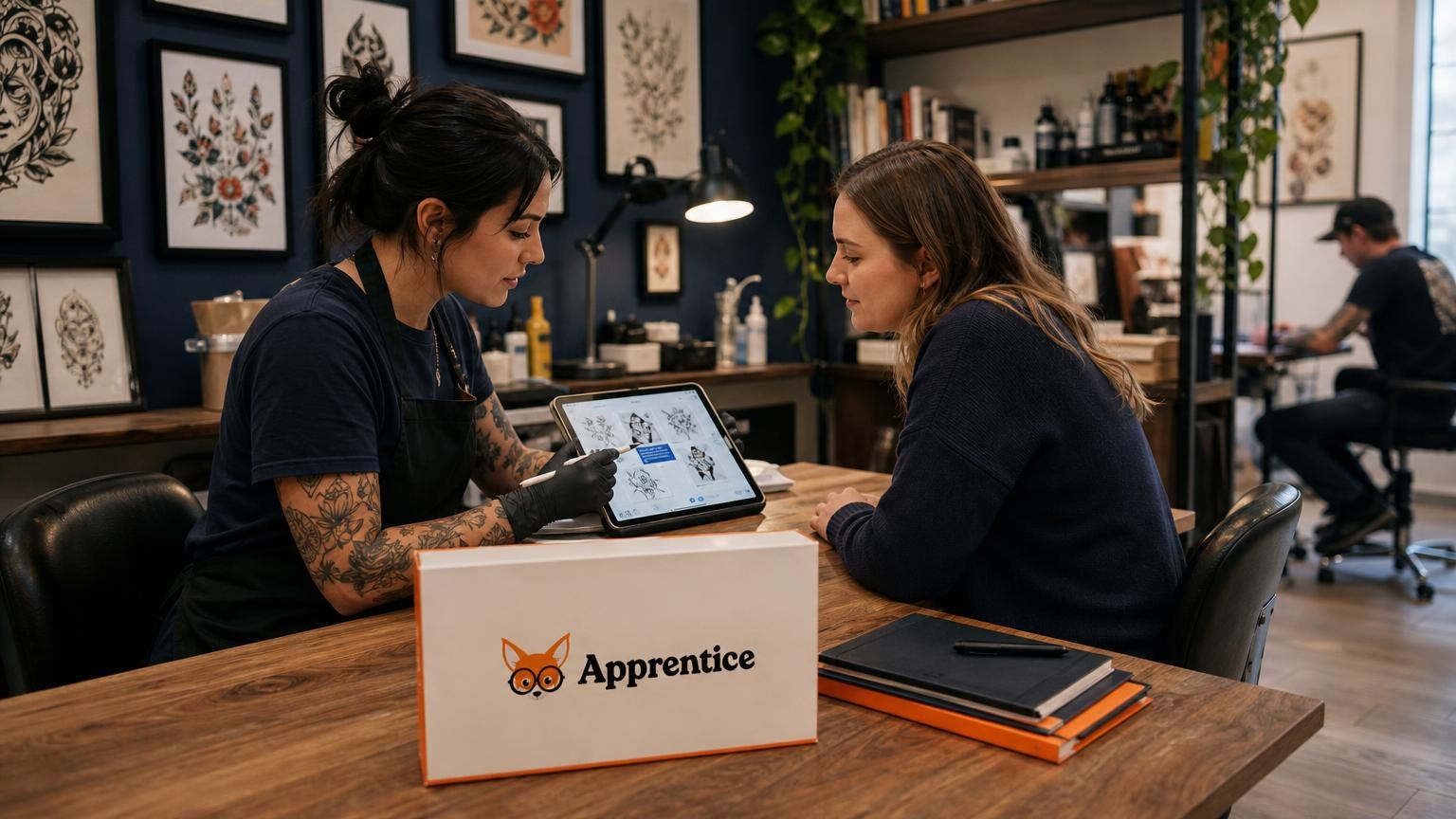
A no-show doesn’t just cost you an afternoon. You already drew the piece, blocked the hours, turned down other bookings, and got your head into a specific tattoo. Then nobody walks in. The deposit is the one thing standing between that and working for free.

Plenty of artists skip this or pick a number out of the air. Both are mistakes. The deposit is a tool, and like any tool it works better when you understand what it’s actually for.
What a deposit really does
A deposit is a partial payment you collect before the appointment. It holds the slot, and it pays you for prep time if the client bails. That’s the mechanical part.
The real job is filtering. Clients who don’t put money down ghost at a rate that’ll surprise you the first time you track it. They forget. They change their minds. They find someone cheaper down the street. Asking for cash upfront quietly weeds out the flaky ones before they eat your Saturday.
There’s a behavior change too. The second someone puts money on the table, they’re invested. “Yeah, that sounds cool” turns into an actual appointment. A casual inquiry becomes a commitment they can feel. That shift is most of the value.
How big should it be?
Not every tattoo earns the same deposit. A walk-in flash piece and a full back piece ask completely different things of you, so they shouldn’t carry the same number.
Here’s what moves the dial:
- Design time. Custom work means hours at the drawing table before the client ever sits down.
- Session length. A longer booking is more lost income if it falls through.
- Supply cost. Big pieces burn through more ink, needles, and setup.
- Your hourly rate. What’s an empty chair actually worth to you?
- Your market. What do the respected artists near you charge?
Run the math on a real booking. A two-hour session at $150 an hour blocks $300 of your time. A $50 deposit barely covers the drawing, let alone the empty chair if they vanish. On that job you want $100 to $150 before it stops being a gift to the client. Still sorting out your base rate? This breakdown of hourly versus flat-rate tattoo pricing will help you land on a number.
For a multi-session piece, think about the whole project. A sleeve that runs $3,000 across five sittings deserves a deposit that matches. Taking $50 to hold months of work makes no sense.
Where you are in your career matters too. Established artists with a waitlist can ask for more because demand backs it up. If you’re newer and still building, start lower to ease the booking, but never so low that a no-show doesn’t hurt.
Flat or percentage?
The industry has rough standards, not rules. Most artists land between $50 and $200 as a flat deposit, or 10% to 50% of the estimated total.
| Tattoo type | Common deposit | Percentage equivalent |
|---|---|---|
| Small flash | $50-75 | 25-50% |
| Medium custom | $100-150 | 15-25% |
| Large custom | $150-300 | 10-20% |
| Multi-session | $200-500 | 10-15% of total |
Flat deposits are predictable. You know what’s coming in, the client knows what to budget, and nobody argues over an estimate.
Percentages scale with the job. A 20% deposit on a $2,000 piece is $400, which protects you a lot better than a flat $100 when the risk is that much bigger.
A lot of artists run both. Set a floor, say $100, and charge a percentage once the job crosses some threshold. You get baseline protection on the small stuff and proper coverage on the big stuff. Whatever you pick, the number has to be enough that flaking actually costs the client something. If it doesn’t sting, it isn’t doing its job.
Put the policy in writing
Verbal agreements are worthless when someone wants their money back three months later. Get it in writing and make people acknowledge it before you take a cent.
Your policy should spell out:
- The exact amount or percentage.
- What the deposit covers: design time, scheduling, supplies.
- Whether it’s refundable, and under what conditions.
- Rescheduling rules and any fees.
- How much notice a cancellation needs.
Then put it where people see it. On your site, in your booking confirmation, on the form they sign. Don’t bury it in fine print, because buried policies don’t hold up when someone pushes back. Most states let you keep a non-refundable deposit if it was clearly disclosed before payment. The operative word is clearly.
Digital consent forms with a timestamp and signature give you a real trail. If a dispute ever lands at your payment processor or in small claims, you can point to exactly what the client agreed to and when. A captured signature, IP, and timestamp do what a text thread never will.
One caution: keep the amount reasonable. A $500 deposit on a $200 tattoo reads as a penalty, not compensation, and that’s the kind of policy a court will toss. Deposits should cover your loss, not punish the client.
Handling the messy stuff
Someone always has an excuse, and everyone thinks they’re the exception. Decide how you’ll handle the common cases before they show up, then handle them the same way every time. Consistency is what kills the arguments.
A timeframe that works for most chairs:
- More than 72 hours’ notice. The deposit moves to the new date.
- 24 to 72 hours. Part of it transfers, part is forfeit.
- Under 24 hours or a no-show. You keep all of it.
- Real emergencies. Case by case, with documentation.
The 72-hour window gives you a shot at filling the slot. Anything tighter and you’re probably eating the income, so you keep the deposit. Be firm without being cruel. Life happens, and how you handle a rough situation follows you.
For rescheduling, decide upfront whether changes are unlimited or capped. One free reschedule, then a new deposit for any more, stops the chronic rescheduler from sitting on your calendar forever.
When someone ghosts, don’t chase them. Send one follow-up after the no-show. No answer in a week? Close the file and move on. The deposit is yours. You earned it.
Keep all of it in your client records. When someone swears they “never got the reminder,” the timestamped messages and signed form settle it fast. Client profiles with appointment history and notes give you the context to stay calm and factual.
Reminders and a clean handoff
Confusion is what breeds the fights, so make the policy plain enough for someone who’s never been tattooed. Your confirmation should show the amount paid and date, the appointment details, what happens if they cancel, what happens if you cancel, and how the deposit applies to the final balance.
Don’t assume anyone reads all of it. Highlight the parts that matter and remind them before the session. Automated reminders ahead of an appointment cut no-shows in a way that’s hard to overstate, and they keep your cash flow steady. Tools that collect and track deposits right at booking take the whole thing off your plate.
It also helps to explain the why, not just the rule. Tell people the deposit pays for your design time and holds a spot you’re turning other clients away to keep. A line like “this reserves your spot on a limited calendar, and I turn down other work to hold it” does a lot of quiet work. People respect a policy they understand.
If you can, fold consent forms and deposit collection into a single prep link so clients arrive with the paperwork done and the money in. For the full setup, here’s how to take deposits without getting burned.
A few common questions
Can I keep a deposit if a client cancels? Usually, yes. A non-refundable deposit holds up when it was clearly disclosed before payment, acknowledged by the client, and reasonable next to the price of the work. Courts tend to back deposits that cover a real loss like design time and a blocked slot.
Same deposit for every tattoo? No reason to. Tier it by size and complexity. A $50 floor fits small flash; a big custom piece might warrant $200 or more, and a percentage scales on its own as the job grows.
A client keeps rescheduling. Now what? Put a limit in your policy. One free move, then a new deposit. If they’re past two reschedules, ask yourself whether they’re worth the calendar space.
A client disputes the charge with their bank. This is the whole reason you document. Signed forms, timestamped agreements, and a clear acknowledgment give you evidence for the chargeback. Processors lean toward merchants who can prove the customer agreed before paying.
Your time has a price and your work earns respect. A deposit policy is how you make both stick. Look at what you’ve got now, even if “what you’ve got” is nothing, and tighten it this week. If you want the collecting, reminders, and records handled in one place, start with Apprentice and let the system hold the line for you.

Jason Howie
Founder & CEO
Jason Howie is the founder of Apprentice, passionate about empowering tattoo artists and shops with better tools to manage their business and serve their clients.