
Most bad tattoo experiences start before the needle. They start in a rushed consultation where nobody said the hard part out loud.
The consultation is where an idea turns into a plan. Four things have to get settled: what the design actually is, where it goes on a body that curves and ages, what it costs, and who signs off at each step. Settle those, and the appointment is calm. Skip them, and you’re having the worst version of that conversation later, with a stencil already on someone’s arm. There’s a whole separate headache about what to do when a client wants changes on the day, and a good consultation is how you avoid most of it.
This works whether you’re the artist running the room or the client sitting in the chair. The goals are the same. Nobody gets surprised.
Talk about the design before you talk about anything else
Words are terrible at describing tattoos. “Something floral” covers ten thousand tattoos that look nothing alike. So bring pictures.
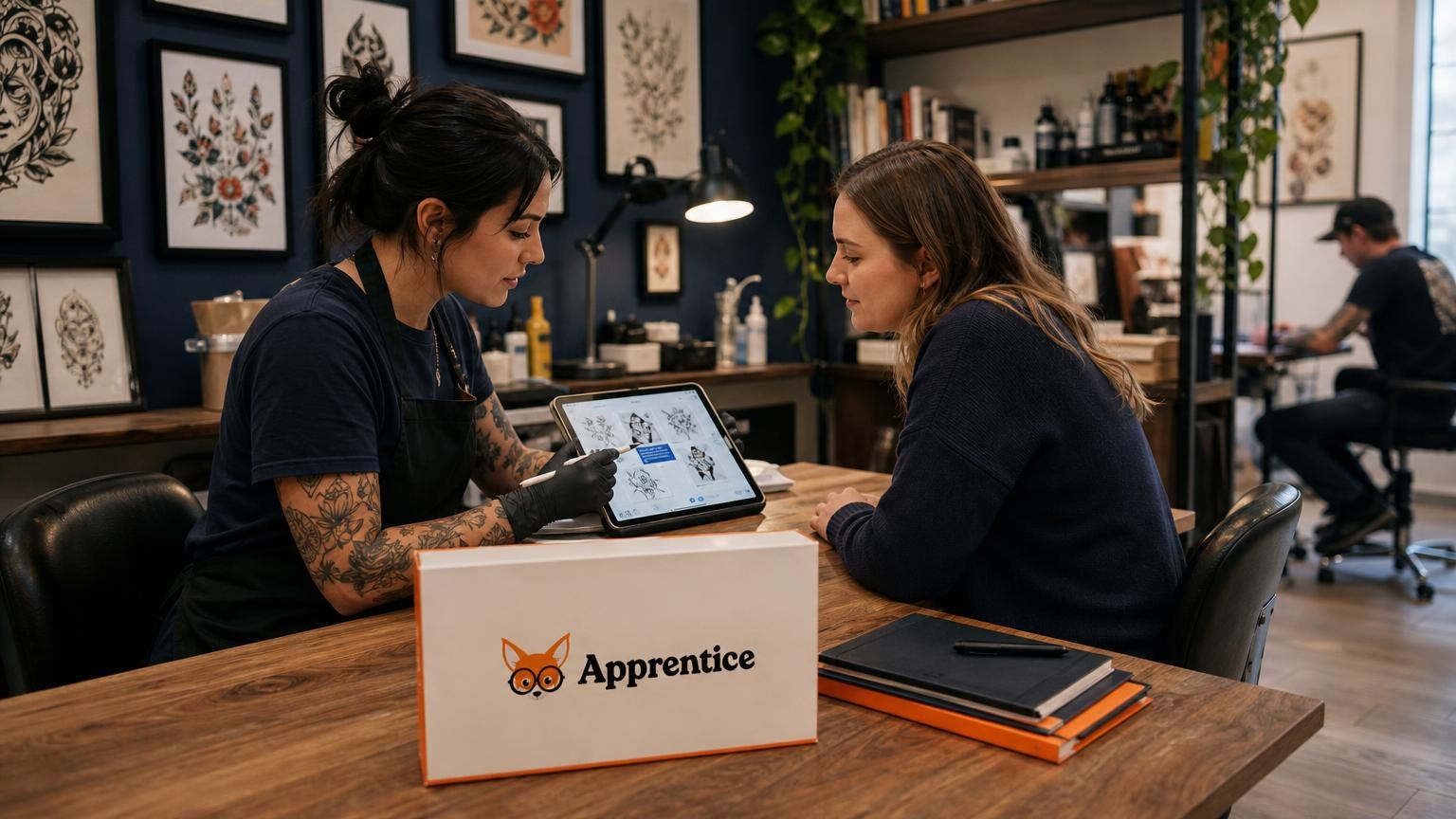
If you’re the client, walk in with visual ammunition. Screenshots, saved photos, a Pinterest board, whatever you’ve got. It helps to sort them a little:
- Style: the approach you’re drawn to, like traditional, fine line, blackwork, or realism
- Subject: specific images of the thing you want
- Placement: photos of similar work in the spot you’re picturing
- Color: if you want it, show the tones you actually mean
- What you hate: sometimes the fastest way to land a design is showing what to stay away from
Don’t apologize for bringing too much. Artists would rather have ten references than “I trust you, just do whatever.” That sounds generous. It usually ends in disappointment, because the artist guessed and guessed wrong.
Be honest about the boring stuff too. First tattoo? Say it. Nervous about a particular spot? Say that. Your artist has seen every kind of client and adjusts the plan accordingly. Nothing you admit is going to surprise them.
Then the artist takes your pile of references and runs it through their own eye. That’s the point of hiring one. This is the part where they push back. Maybe the design has too much detail for the size you asked for. Maybe the composition won’t sit right where you want it. That pushback isn’t them being precious. It’s the difference between a tattoo that reads in ten years and one that turns into a smudge.
So ask why. “Why bigger?” isn’t a challenge, it’s you learning the trade for thirty seconds. Most artists love explaining it to a client who’s actually paying attention.
Placement is anatomy, not decoration
Where the tattoo goes matters as much as what it shows. A body isn’t a flat sheet of paper. It bends, it stretches, it changes shape over the years, and ink moves with it.
Some spots are just harder, and clients should hear it straight:
- Ribs and spine: thin skin over bone, so more pain and more chance of the ink spreading
- Inner arms: soft skin that can blur faster than the outer arm
- Hands and feet: high-abuse areas that fade quicker and need upkeep
- Joints: elbows, knees, and knuckles stretch all day, which is rough on line work
- Curved surfaces: the design has to wrap without warping
Movement is part of it. A tattoo placed while the arm hangs relaxed can look strange when the arm is raised. This is why the artist makes you stand up, sit down, and move around during stencil placement. Watch how the design shifts when you do.
Lifestyle counts here too. Need to hide it at work? Inner bicep or upper thigh beats forearm. Want it seen every day? Go visible. Neither answer is wrong. They’re just different choices, made on purpose instead of by accident.
It’s going to age, so plan for that
Every tattoo ages. That’s not pessimism, it’s physics. Ink spreads a little over the years, fine detail softens, and colors fade at their own pace. A good artist designs around that from the start.
A few things drive how a piece holds up. Sun is the worst of them, since UV breaks pigment down faster than anything else. Bold lines outlast ultra-fine ones. Darker colors hold longer than light ones. And high-friction spots simply wear down sooner.
This is why an artist might nudge you bigger than you wanted. Small, busy designs tend to go muddy after a decade. A slightly larger version keeps its shape and stays readable into old age. Worth asking the question outright: how do you think this looks in ten years? In twenty? An honest answer tells you whether to change anything now, while changing it is still easy.
Touch-ups are normal. Plan on them. Many artists cover a touch-up within the first year, and after that you’re paying to maintain it every so often, especially on color or high-wear placements. None of that is a sign something went wrong. It’s just upkeep on art that lives on skin.
Say the budget number out loud
Money talk feels awkward and shouldn’t. Pricing follows a logic, and saying your real number early makes everyone’s life easier.
If you’re the client and you’ve got a hard ceiling, name it. The artist can scale the design, simplify it, or suggest another approach that fits. They can’t read your mind, and finding out at the register helps no one.
What actually moves the price:
- Size: bigger means more time, more ink, more physical work
- Detail: intricate pieces take more skill and more focus
- Color vs. black and grey: color often runs longer and needs more passes
- Placement: the difficult spots like ribs, hands, and neck can cost more
- Experience: an established artist charges for the years behind the work
- Location: shop overhead swings hard from one city to the next
Most artists work either by the hour or by a flat rate for the whole project. Hourly is common and the rate climbs with experience and location, so ask what theirs is and why. Flat rates suit jobs where the scope is already nailed down. Either way, ask for an estimate before you commit, and ask what could push it up or down. No real artist takes offense at a budget question.
Don’t shop on price alone. The cheap tattoo from a kitchen-table setup has a way of costing far more once you’re paying a better artist to fix or cover it. This is permanent. Budget like it.
The costs that hide behind the session fee
The session isn’t the whole bill. A few extras add up, and it’s better to know them going in than to get nickeled at the end:
- Deposit: usually somewhere from fifty dollars up to a couple hundred, and it comes off your final total
- Tip: customary, in the same neighborhood as tipping at a restaurant or salon
- Aftercare: a small spend on decent healing supplies
- Touch-ups: often free or cheap early on, then a maintenance cost later
- Travel: if you’re chasing a specific artist out of town, count the trip
Deposits earn their keep. They hold your slot, they pay the artist for design time if you bail, and they prove you’re actually showing up. Most shops post their deposit and cancellation policy. Read it before you hand anything over.
Payment timing varies. Some shops want it all upfront, some collect when you’re done, and big multi-session pieces often run on milestone payments. Nail that down at the consultation so it’s not a weird moment later.
This is one place Apprentice earns its keep for a shop, since deposits, balances, and appointment history all sit in one record. The client sees what they owe, the artist sees what’s been paid, and the awkward “wait, did you cover the deposit?” conversation never happens.
Build in the moments to say stop
A tattoo has a few points where someone can still change course. After ink hits skin, that window slams shut. So put the checkpoints in on purpose.
Design approval, before the day. Most artists send a concept ahead of time. Sit with it. Zoom in. Picture it on your body and sleep on it. Then give feedback you can act on: “make the rose a touch bigger,” “different font on the text,” “shading’s too heavy on the left.” Vague feedback like “something feels off” leaves the artist guessing. Be specific, not harsh. Most artists build a revision round or two into the price, so ask what’s included before a big overhaul racks up extra.
Stencil approval, on the day. The stencil goes on before any tattooing, and this is the last real chance to move anything. Take your time. Move around, check the mirror, ask for photos from angles you can’t see. Look at the position, the angle, the size on your actual body, and whether it’s balanced. Speak up now or live with it, because once the machine starts, repositioning is off the table. Any artist worth booking would rather wipe and redo a stencil than ink a tattoo you’ll resent.
Progress checks, during the work. On longer sessions, ask to see how it’s coming, especially on color where saturation builds as it goes. Want a break to stand up, breathe, or just look? Ask. That’s an engaged client, not a difficult one.
A few common questions
How long does a consultation take? Short ones for simple pieces, longer for involved custom work. A quick first chat can happen over video, with the in-person time saved for final details and the stencil.
Should I bring more than one idea? Yes, even if you think you’ve already decided. Options help the artist read your taste and can surface a direction you hadn’t considered. More to work with beats less.
What if I can’t afford the dream piece yet? Say so. An artist can usually trim the design to fit the budget while keeping its spirit, or split a big piece across sessions over time. Most prefer that to rushing it.
Can I haggle on price? Not really. The number reflects skilled labor and years of training, and asking for a discount lands badly. Adjust the scope instead. A smaller piece done well beats a bigger one done in a hurry, every time.
The tattoo is permanent. The conversation that leads to it doesn’t have to feel like one. Come in prepared, talk about placement and money like adults, and lean on your artist while still speaking up for what you want.
If you run a shop and you’re tired of deposits, balances, and appointment notes living in five different places, start with Apprentice and keep the whole consultation in one record from the first message to the final touch-up.

Jason Howie
Founder & CEO
Jason Howie is the founder of Apprentice, passionate about empowering tattoo artists and shops with better tools to manage their business and serve their clients.